
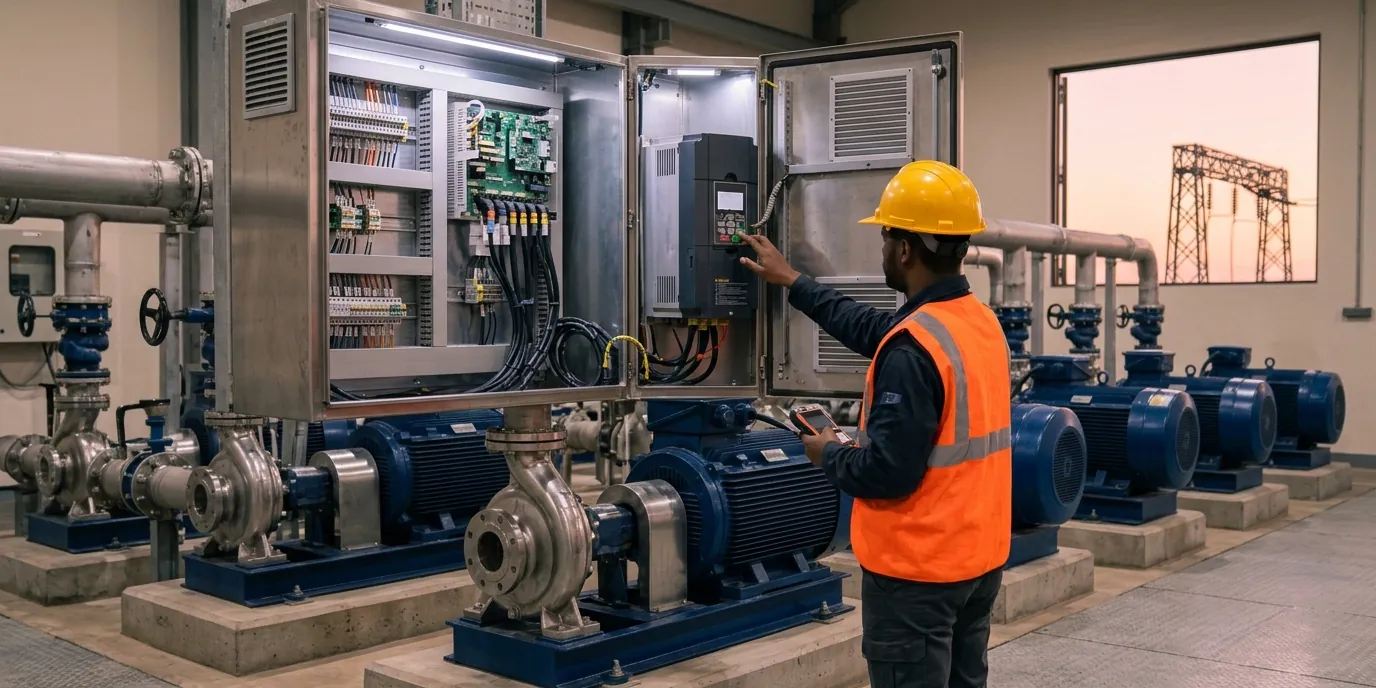
Everything you need to know about Variable Frequency Drives for pumps, fans, compressors, and beyond — from affinity law calculations to brand comparisons and BEE recommendations.
Section 01 · Fundamentals
What Is a Variable Frequency Drive?
A Variable Frequency Drive (VFD) — also called an AC drive, inverter, or variable speed drive — is an electronic controller that adjusts the speed and torque of an AC induction motor by varying the frequency and voltage of its power supply.
Instead of running a motor at full speed and throttling output mechanically (via valves, dampers, or bypass), a VFD delivers only the energy the process actually demands. This fundamentally changes the economics of motor-driven systems.
Why this matters in India: With manufacturing energy costs rising and BEE tightening efficiency norms, VFDs have become the single most impactful retrofit for reducing industrial power bills. Electric motors account for roughly 60% of all industrial electricity consumption globally — yet the vast majority of installed AC motors still run at fixed speed, leaving substantial savings on the table.
Section 02 · Under the Hood
How a VFD Works: Three-Stage Power Conversion
Every VFD converts incoming fixed-frequency AC power into variable-frequency AC output through three internal stages.
Rectifier
Converts incoming 415V AC power into DC using a diode or thyristor bridge. Creates a stable DC bus voltage from the plant's 3-phase supply.
DC Bus
Capacitors smooth the rectified DC, forming a stable energy reservoir. Typically ~586V DC for a 415V input in Indian installations.
Inverter (IGBT)
IGBT transistors switch rapidly using PWM to synthesize variable-frequency AC output. This controls motor speed precisely.
The key relationship: Motor Speed (RPM) = 120 × Frequency / Number of Poles. A standard 4-pole motor at 50 Hz runs at ~1440 RPM. Drop the VFD output to 40 Hz and the motor slows to ~1152 RPM — and the energy savings on centrifugal loads are dramatic, thanks to the Affinity Laws in Section 04.
Section 03 · Where to Deploy
Industrial Applications for VFDs
VFDs shine across virtually every motor-driven process, but the savings profile varies dramatically by load type.
Pumps
Cooling water, boiler feed, process transfer, and RO plants. Variable-torque loads where the cube law delivers maximum savings.
Fans & Blowers
AHUs, ID/FD fans, cooling towers, and dust collectors. Even a 20% speed reduction cuts power by nearly 50%.
Compressors
Screw compressors and centrifugal chillers. VFDs prevent wasteful load/unload cycling and match output to air demand.
Conveyors
Material handling, bottling lines, and packaging. Constant-torque loads see proportional savings plus softer starts.
Mixers & Agitators
Chemical reactors, food processing, and pharma. VFDs enable precise speed control critical to product quality.
HVAC Systems
Chiller plants, AHU fans, and condenser pumps. VFDs are the backbone of modern BMS-controlled HVAC efficiency.
Key insight — Load type determines ROI: VFDs deliver exponential savings on variable-torque loads (pumps, fans, blowers) thanks to the cube law. On constant-torque loads (conveyors, extruders), savings are proportional — still worthwhile, but payback is longer.
Section 04 · The Science of Savings
Affinity Laws: Why Small Speed Cuts = Massive Savings
The Affinity Laws are the physics behind VFD savings. For centrifugal equipment — pumps, fans, blowers — they define three relationships between motor speed and performance.
Practical Example — 75 kW Cooling Tower Fan
A 75 kW cooling tower fan at full speed draws 75 kW. Reduce VFD frequency to 80% speed:
That is a 48.8% reduction in power from just a 20% speed decrease. At Rs.8/kWh running 6,000 hrs/year, the annual saving is Rs.17.6 lakhs — on a single motor.
Section 05 · Interactive Tool
VFD & Motor Efficiency Savings Calculator
Enter your motor details below to estimate annual energy and cost savings. The VFD tab uses the Affinity Law (cube rule) for variable-torque loads.
At 80% speed: Power = (0.80)³ = 51.2% of full load
Rs.6.6L
Annual Savings
82 MWh
Energy Saved
67.2 t
CO₂ Avoided
0.2 yr
Payback
Section 06 · Buyer's Guide
VFD Selection Criteria for Indian Facilities
Choosing the wrong VFD wastes money and invites reliability problems. Here are the six critical parameters every plant engineer should evaluate.
HP / kW Rating
Must match or exceed connected motor rating. Account for overload — typically size VFD at 110–120% of motor Full Load Amps (FLA).
Voltage Class
415V 3-phase is standard in India. Verify compatibility with your transformer secondary voltage. For HT motors (3.3 kV / 6.6 kV), medium-voltage VFDs are required.
Load Type
Variable torque (fans, pumps) vs. constant torque (conveyors, mixers) determines control mode and derating. Get this wrong and the VFD will trip on overload.
Enclosure / IP Rating
IP20 for panel mounting in clean MCC rooms. IP54/IP65 for dusty, humid, or outdoor Indian installations. Higher IP adds cost but prevents premature failure.
Control Method
V/f for simple fan/pump loads. Sensorless Vector for most industrial uses. Closed-loop Vector with encoder feedback for high-precision torque.
Communication Protocol
Modbus RTU is most common in Indian plants. Profinet for Siemens, EtherNet/IP for Allen-Bradley/Rockwell. Ensure your VFD speaks to your SCADA/PLC.
Section 07 · Market Landscape
Top VFD Brands in India
India's VFD market features a mix of global automation giants and cost-effective regional players.
| Brand | Origin | Popular Series | Key Strength for Indian Industry |
|---|---|---|---|
| ABB | Switzerland | ACS580, ACS880 | Robust industrial heritage, widest service network across India |
| Siemens | Germany | SINAMICS G120, V20 | Deep PLC/SCADA integration, excellent for complex automation |
| Danfoss | Denmark | VLT AQUA, VLT HVAC | Pioneer in VFDs since 1968, best-in-class for pumps & HVAC |
| Delta | Taiwan | MS300, C2000+ | Most cost-effective, massive Indian distribution network |
| Schneider | France | Altivar 320, 630 | EcoStruxure digital integration, strong in building automation |
| Yaskawa | Japan | GA500, A1000 | Premium precision control, favoured in CNC & robotics |
Choosing a brand: For most Indian pump/fan/compressor applications, ABB, Danfoss, and Delta dominate due to price-performance and local service. For Siemens PLC plants, SINAMICS offers seamless integration. Schneider's Altivar excels in building/HVAC with EcoStruxure.
Section 08 · Regulatory Landscape
BEE & Government Recommendations for VFD Adoption
India's regulatory framework increasingly pushes industrial facilities towards VFD adoption through compliance, incentives, and mandatory efficiency standards.
PAT Scheme (Perform, Achieve, Trade)
India's flagship industrial efficiency programme under BEE. Designated consumers receive SEC reduction targets. VFD retrofits on pumps, fans, and compressors are among the most common measures to meet PAT targets and earn ESCerts.
ECBC & BEE Star Ratings
The Energy Conservation Building Code mandates VFDs for HVAC systems in commercial buildings above specified thresholds. BEE's star-rating programme for motors (IS 12615) pushes IE3/IE4 adoption — pairing with VFDs multiplies savings.
BEE Motor Standards (IS 12615:2018)
India mandates minimum IE2 efficiency for motors from 0.37–375 kW. BEE recommends upgrading to IE3 and coupling with VFDs for all variable-load applications — reducing consumption by 40–60%.
State DISCOM Incentives
Several state electricity boards and DISCOMs offer rebates, subsidised audits, and DSM programmes that subsidise VFD installations — especially for agricultural pumping and municipal water supply.
Section 09 · Common Questions
Frequently Asked Questions
Continuous Energy Intelligence
Stop Guessing Which Motors Need VFDs. Let Data Decide.
Zerowatt's AI platform monitors every motor across your facility — current, power factor, load profile, run hours, and vibration. It identifies which motors would benefit most from VFDs, quantifies the savings, and prioritises retrofits by payback period.